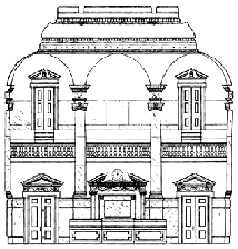
 17th Century. The Senate of Maryland originated as the Upper House of the General Assembly, formally distinguished from the Lower House in 1650. This division provided "for the more convenient dispatch of the busines therein to bee consulted of" (Chapter 1, Acts of 1650). Since the Upper House consisted of the Governor and his Council, all of whom held close personal and political ties with the Lord Proprietary, the separation of the two Houses gave Lord Baltimore control of the legislature. The political interests of the Upper House regularly came in conflict with those of the Lower House, which advocated a popular government and more legislative influence.
Senate Chamber, Annapolis, Maryland. Architectural drawing, Historic American Buildings Survey (Maryland State House Project Collection, MSA SC1773, Maryland State Archives).
![[color photograph of Senate Chamber, State House, Annapolis, Maryland]](/msa/mdmanual/05sen/images/i005987a.jpg) In the decade following its creation, the bicameral system faced several major challenges. Many were rooted in colonial politics, but some grew out of religious conflicts and the English Civil War. Puritan governors, appointed by the Parlimentary Commissioners in England, twice convened unicameral legislatures in Maryland, first in 1654, and again in 1657. Catholic Lord Baltimore regained control of the colony in 1658 with the aid of several loyal Protestants, including Josias Fendall. To show his appreciation, Baltimore appointed Fendall governor of Maryland. In 1660 though, Fendall turned traitor, conspiring with the Lower House to abolish the Upper House and establish a commonwealth system of government (Archives of Maryland I: 388-391). "Fendall's Rebellion" was short-lived, as Proprietary forces quickly regained control of the government. Once restored, the Upper House kept the same composition for the next century. The only major change was the removal of the governor's position from the Upper House in 1675.
In the decade following its creation, the bicameral system faced several major challenges. Many were rooted in colonial politics, but some grew out of religious conflicts and the English Civil War. Puritan governors, appointed by the Parlimentary Commissioners in England, twice convened unicameral legislatures in Maryland, first in 1654, and again in 1657. Catholic Lord Baltimore regained control of the colony in 1658 with the aid of several loyal Protestants, including Josias Fendall. To show his appreciation, Baltimore appointed Fendall governor of Maryland. In 1660 though, Fendall turned traitor, conspiring with the Lower House to abolish the Upper House and establish a commonwealth system of government (Archives of Maryland I: 388-391). "Fendall's Rebellion" was short-lived, as Proprietary forces quickly regained control of the government. Once restored, the Upper House kept the same composition for the next century. The only major change was the removal of the governor's position from the Upper House in 1675.
Senate Chamber, State House, Annapolis, Maryland, January 2001. Photo by Diane F. Evartt.
19th Century. The elections of 1838 effected the first major reform of the Senate. Voters ratified numerous Constitutional amendments regulating the geographic distribution of Senate seats, a process which had been overrun by economic, social and political biases. The electoral college was abolished, and voters for the first time chose their senators. Twenty-one senators were elected; one from each county and Baltimore City. Senatorial terms expanded to six years, and a rotational election system was established so that only a third of the senators stood for election every two years. The amendments also abolished the Governor's Council (Chapter 197, Acts of 1836, secs. 2, 3, 13). To this day though, the Senate still functions as the Governor's Council when it confirms or rejects appointments made by the Governor.
Despite the political turmoil of the mid-nineteenth century, in Maryland, the Senate experienced only minor changes. The Constitution of 1851 reduced senators' terms to four years, while the Constitution of 1864 divided Baltimore City into three legislative districts, each with their own senator. The Senate was left untouched by the Constitution of 1867, and would remain so for nearly a century.
![[color photograph of James Senate Office Building, Annapolis, Maryland]](/msa/mdmanual/05sen/images/i005992a.jpg) James Senate Office Building, Annapolis, Maryland, January 2001. Photo by Diane F. Evartt.
James Senate Office Building, Annapolis, Maryland, January 2001. Photo by Diane F. Evartt.
A Constitutional amendment approved by the voters in 1972, continued the process of electoral reform. The amendment created 47 legislative election districts based on population. For the first time, districts encompassed parts of a county, multiple counties, or parts of adjoining counties. Since the 1974 elections, each of the General Assembly's 47 senators has been elected from one of these districts.
© Copyright Maryland State Archives